
What will it look like if Nepal were to place Economic Diplomacy at the front and centre of its bilateral relations with New Zealand?
INTRODUCTION
Economic diplomacy (आर्थिक कूटनीति) is one of the key foreign policies of the Nepal Government[1].
Economic diplomacy, in a nutshell, is the use of a government's foreign policy and diplomatic tools to advance national economic interests, such as increasing trade, attracting foreign investment, and ensuring economic security.
Diplomatic Missions, in Nepal’s case its embassies, are responsible for implementing and executing the government’s foreign policies in the respective countries where the missions are based and have their jurisdiction. The Nepal embassy based in Canberra has diplomatic jurisdiction also in New Zealand.
In this article I will discuss a few potential initiatives that should be achievable if the Nepali diplomatic mission in Canberra places economic diplomacy at the front and centre of its foreign policy in New Zealand.
LEGACY OF BILATERAL RELATIONS
Friendly relations between Nepal and New Zealand started in 1953 after the first ascent of Everest. Formal bilateral diplomatic relations between Nepal and New Zealand were established on May 1, 1961. Both countries to this day share cordial bilateral relations, mainly built on the foundation of Sir Ed’s legacy.
According to the New Zealand Ministry of Foreign Affairs, cooperation between the two countries involve development assistance in areas such as education, capacity building, and agriculture[2]. In April 2015, New Zealand provided an aid of two million dollars to assist Nepal in the aftermath of the then devastating earthquake. Similarly, in May 2021, the New Zealand government supported Nepal through an aid of one million to help combat COVID-19. The New Zealand government continues to support the Himalayan Trust which has been providing its services in the Everest Region since the 1960s.
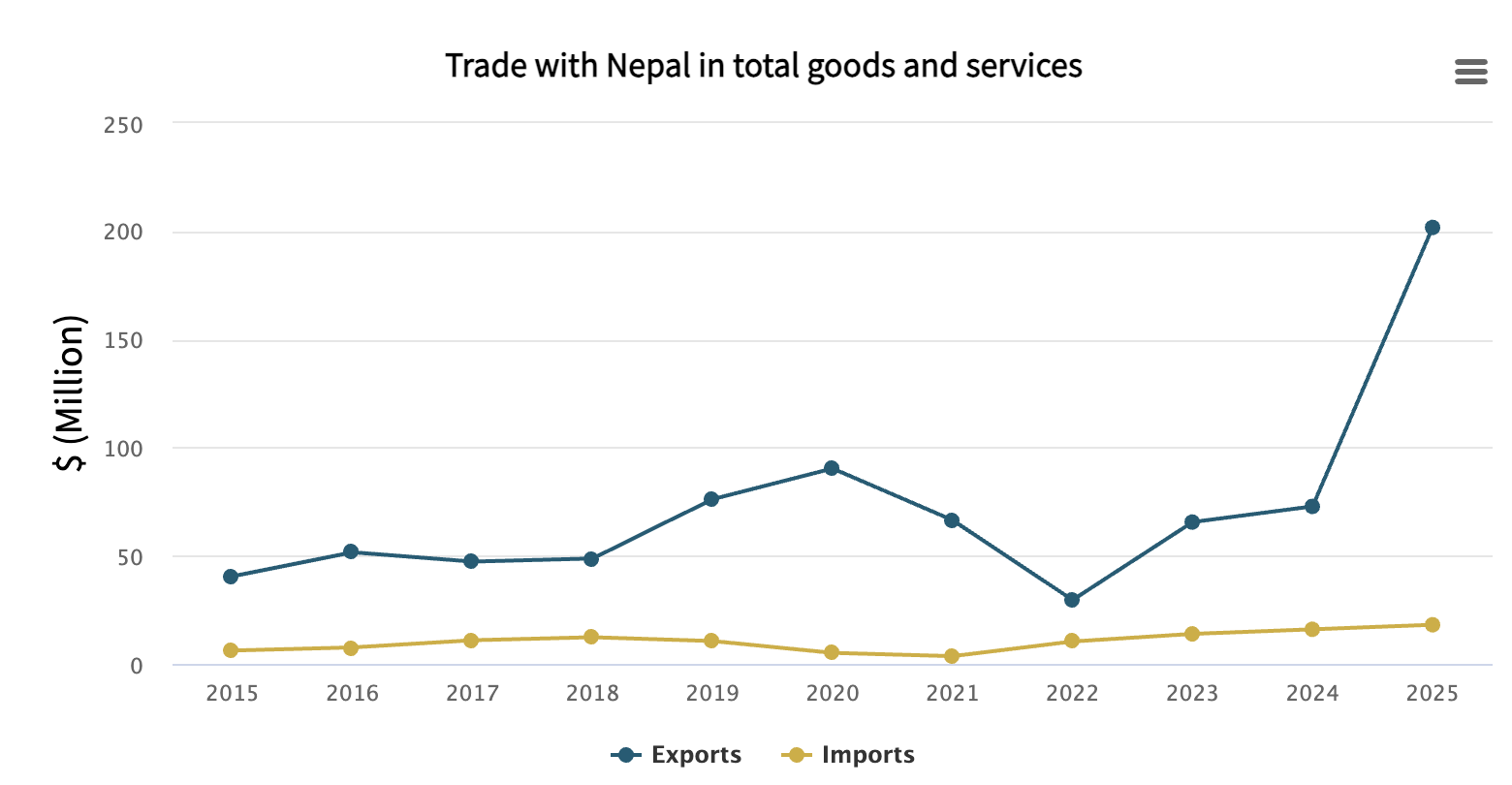
Trade figures of 2015-2015 from Stats NZ shows that New Zealand in average exported approximately $50-100 millions worth of goods and services to Nepal, which increased to $200 millions in 2025. Import from Nepal to New Zealand hovers around $10 million annually.
Nepal contributes a substantial amount to New Zealand, albeit official dollar figures are not available, through the tuition and living cost paid by Nepali international students. According to a figure obtained from the MBIE by a New Zealand based Mt 8848 Football Club, there were 1,640 students from Nepal as at 1 March 2026. Even by a conservative estimate of each student contributing $20,000 a year, Nepali international students contributed approximately $23 million to the New Zealand economy. New Zealand recognises international education as one of its export earnings. From my observation, the flow of Nepali international students in New Zealand has been steadily growing since 2015.
BILATERAL RELATIONS TODAY
Until today, both Nepal and New Zealand do not have embassies in respective countries. The Nepal Embassy based in Canberra has jurisdiction in New Zealand. The New Zealand High Commission to India based in New Delhi is also responsible for diplomatic relations with Nepal. Both Nepal and New Zealand have appointed Honorary Consuls in respective countries.
Appointment of Honorary Consuls of Nepal to New Zealand is a relatively new practice dating back to only a few years. The Honorary Consul’s office mainly provides consular services and promotes bilateral relations between the two countries.

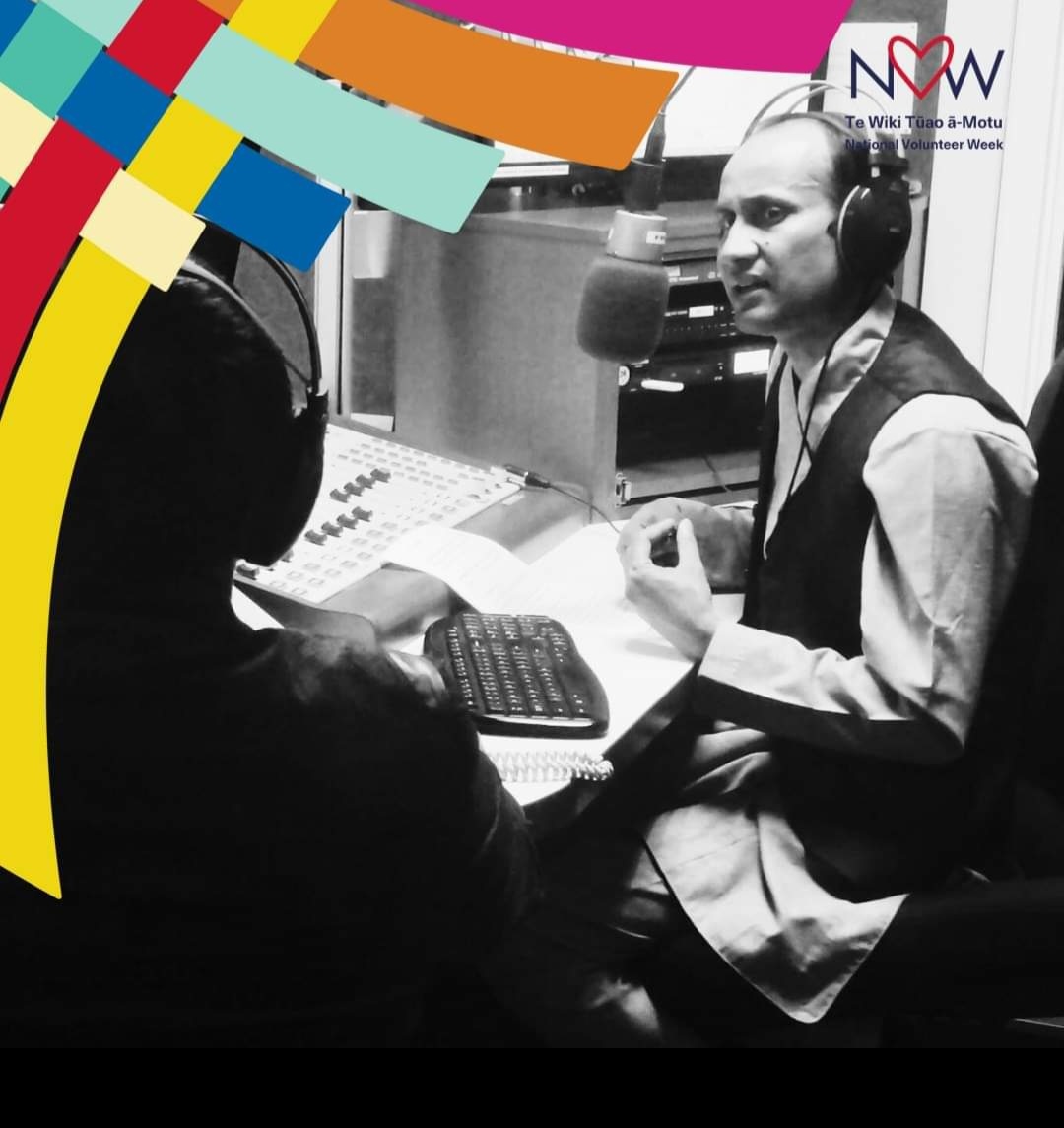
I had personally met the New Zealand ambassador to Nepal, Patrick John Rata, in a business function in Auckland in 2025. During the meeting, my experience from brief conversation with the ambassador has been that New Zealand is keen to explore mutual economic opportunities, specifically in the areas of trade and investment. Prior to the then Foreign Minister, Winston Peter’s state visit to Nepal, I had written to the minister requesting to initiate dialogue about mutual business and trade promotion between the two countries. Following the state visit, the minister has replied to my message with a cordial appreciation of that advice. Prior to the state visit, I had also had a live interview with RNZ on the issue of promoting trade and business between Nepal and New Zealand[3].
FUTURE OF BILATERAL RELATIONS
The Stats NZ figure above clearly demonstrates that Nepal has a huge trade deficit when it comes to its trade with New Zealand. Although the dollar figure of the trade is relatively small, there are opportunities for the trade volume between the two countries to increase and Nepal’s deficit to decrease. Tapping the potential opportunity with New Zealand will only be feasible by placing economic diplomacy at the front and centre.
Fruits of a successful economic diplomacy might look something like those outlined below:
- Seek more trade, less aid
- We will see a shift towards an increase in trade of goods and services from both countries. Nepal’s trade deficit will decrease.
- The model of educational assistance through the NZAID will change from scholarship quotas towards student and teacher exchange offering mutual co-operation.
- New Zealand has a good track record in good governance, disaster management, financial management, adventure tourism, agri-business, sports (mainly cricket), Artificial Intelligence and Climate Change. Nepal could engage Kiwi experts from those sectors, which has huge potential and need in Nepal.
- The Nepal government will send regular trade delegations to New Zealand to explore areas where mutual trade and investments can be initiated and increased.
- Improve connectivity - Nepal Government would be exploring better air route connection with New Zealand by facilitating code-sharing with airlines such as Air New Zealand and QANTAS. I understand that Nepal Airlines is soon to operate between Sydney and Kathmandu. Such code sharing flights would make it possible to connect that Nepal Airlines flight with Auckland.
- Negotiate respect based on economic contribution - Nepal Government will negotiate with the New Zealand government to ensure that its citizens who are based in New Zealand and are contributing towards the New Zealand economy are living a life of dignity and respect. Those include the international students and those in work visas. This will result in a lesser amount of cases of distress among the international students, and rightful pay and services for the workers.
- Explore better opportunities
- Nepal Government’s future endeavour must be to stop brain drain and to employ its workforce in Nepal, not overseas. However, for the foreseeable future Nepali citizens will continue to seek opportunities elsewhere. It is fair to say that New Zealand is a relatively better destination for the Nepali employment seekers. Nepal Government will explore the Working Holiday Visa option which allows Nepali citizens to work in New Zealand for a short-term.
- Nepal Government will seek opportunities for its high-skilled workforce in New Zealand. The learning and experience of those workforce would be a valuable asset for Nepal.
HOW IS THIS POSSIBLE?
As I outlined in the opening sentence of this article, Nepal already has economic diplomacy as a key policy on paper. It is now time to put that in practice.
By the time this goes into publication, Nepal would have had a new government with a resounding majority after a mandate from a recently concluded general election. To unlock the economic opportunities with New Zealand (and the rest of the world), the new government must place economic diplomacy at the front and centre.
To achieve tangible outcomes, each ambassador must be given a set of economic diplomacy key performance indicators (KPI) that they are required to implement in their countries of jurisdiction. Diplomatic appointments must be based on capacity to deliver on those KPIs, not a retirement opportunity for seasoned politicians.
CONCLUSION
Nepal’s foreign relations is not only a matter of economy, it is also a matter of dignity of Nepal, Nepali citizens and Nepalis living overseas. When and if the Nepal government approaches its foreign policy with a focus on economic diplomacy, the tone and language of foreign nations will change. We would be seen and treated with more respect than we are today when we mostly approach foreign relations primarily based on aid.
When pursuing economic diplomacy, Nepal must approach it on a win-win basis focussing on mutual benefits. Nepal must start to shift its narrative from what it has (for example, Everest and Buddha) towards what tangible opportunities it has to offer. Nepal must be able to confidently answer the question, ‘why would we invest in Nepal when there is India and China next door?’
It is now high time that we make a paradigm shift in our foreign relations from aid towards business and trade. For the sake of Nepal’s economy and Nepali’s dignity, we have to mean business.
*****